Showing posts with label Daoism. Show all posts

Sunday, August 21, 2011

Living In Balance And Harmony

When you think of living in balance, how do you perceive that balance? Would your life and lifestyle be pretty mellow with no great highs or lows, similar to driving over a terrain of little hills but no tall mountains or deep valleys? You would experience no great ups or downs; nothing to get upset or angry about, but nothing to get excited about either? You would have no major illnesses; you would feel pretty good but experience the occasional “blah” day?

Many people would consider that to be a balanced life and be pretty satisfied with it because most see balance as an apothecary’s scales or a see-saw where there are little ups and downs, but basically “balanced” means horizontal levelness. Take a moment to consider the things we say to warn people off from imbalance: “Don’t tilt the apple cart;” “don’t tip the scales;” “keep it on an even keel.”


That perceived state of balance really means equilibrium: “A condition in which all acting influences are canceled by others, resulting in a stable, balanced, or unchanging system.” When talking about Dao and balance, we can safely agree that there is nothing about the Dao that is unchanging. It is quite the opposite, changing every minute of every day.

Take a moment to ponder all the things around you that are changing right this minute; depending upon the time of day you are reading this the day is changing to night or vice versa, the summer is changing to winter in the northern hemisphere and winter to summer in the southern hemisphere, at the time of this writing the moon is changing from full to new. On a more personal scale, your body is shedding old skin cells and making new ones, your qi is circulating through your energy channels, and your body chemicals are rising and falling in their own rhythm. Many of these things you don’t pay much attention to or even notice in the course of the day, but they affect you just as profoundly as the recognition of hunger or sleepiness or any of several emotions you may be feeling like anxiety or depression or happiness or contentment.

Can you imagine being caught in an ever-balanced, unchanging life? What would that be like? Would it always be spring or autumn so the length of day and night were equal and the seasons would never change to bring extreme heat or cold? Would your thoughts always progress smoothly from one idea to the next? Would you always be emotionally mellow, feeling neither anger nor joy?

When I present “balance” to you that way, it sounds ridiculous, doesn’t it? However, that is exactly the kind of life you create for yourself when you attempt to maintain rigid levels of brain or body chemicals through unnatural measures in an attempt to control unwanted emotions or diseases without getting to the root of the problem to learn why those difficult emotions and diseases are bubbling up in the first place.

In following the Dao, equilibrium is not the sort of balance we are trying to attain.

In his writing “Balance” from the book 365 Tao (1), Deng Ming-Dao reminds us: “Nature does not achieve balance by keeping to one level. Rather, elements and seasons alternate with one another in succession. Balance, as defined by the Tao, is not stasis but a dynamic process of many overlapping alternations; even if some phases seem wildly excessive, they are balanced by others.

“Everything has its place. Everything has a season. As events turn, balance is to know what is here, what is coming, and how to be in perfect harmony with it. Then one attains a state of sublimity that cannot be challenged.”


You can see that balance is not equilibrium, and perhaps that is why equilibrium is so difficult to maintain – it is not natural, it is contrived. If you must spend your energy and attention maintaining equilibrium, you have neither the time nor opportunity to be aware of the cycles which create balance naturally.

In part, the reason equilibrium is so highly valued today is because changes in life come so swiftly and unexpectedly you have little time to adapt to one change before the next challenges you; they come at you like white-capped waves in a stormy sea. Not only is it difficult to keep up with today’s fast-paced technology, but all these labor-saving devices have actually caused American workers to be less productive rather than more productive, and instead of taking less time to complete tasks, it now takes longer. No wonder you become angry, frustrated, and depressed. Life has tossed more complications at you than you can cope with. It is nearly impossible to “know…what is coming, and how to be in perfect harmony with it” as Deng Ming-Dao suggests. You can barely keep up with what’s here and now!

The way to calm the mind and soothe the body is not through chemically forced equilibrium. Generally speaking, chemicals do not help your body to perform natural processes; they supply your body with uniform levels of needed chemicals so your body does not have to perform at all because your natural system has been bypassed. When one body system is bypassed, it affects the performance of a second, related system, and then that second system requires intervention, and so on, in a chain-reaction of chemically-induced stasis which is quite unnatural, and causes more ill-health than it cures.

The correct path to natural balance and wellness can be found in verse 19 of the Tao Te Ching (Peter Merel interpolation (2))

If we could discard knowledge and wisdom Then people would profit a hundredfold; If we could discard duty and justice Then harmonious relationships would form; If we could discard artifice and profit Then waste and theft would disappear. Yet such remedies treat only symptoms And so they are inadequate. People need personal remedies: Reveal your naked self and embrace your original nature; Bind your self-interest and control your ambition; Forget your habits and simplify your affairs.

Here is one interpretation of how this verse instructs you in achieving true, natural balance.


If we could discard knowledge and wisdom Then people would profit a hundredfold;
This does not mean to throw away what you know. It means that the demands for learning that are made upon you may account for the higher levels of stress and anxiety you experience, and may lead to feelings of fear, anger, resentment, and depression. Today, those demands often include becoming proficient in complicated technologies, and learning several jobs so that you are able to cover jobs for other people when they are out sick or on vacation. If the demands made upon you were fewer or less intense, you would not suffer sustained and debilitating levels of energy-draining and disease-causing emotions like anxiety and depression, and you would not require chemical interventions. Yes, you probably would experience these negative emotions, but you would “profit” by having shorter and fewer episodes, and you would have the mind power and the energy to effectively counteract them with techniques such as going for a brisk walk, or doing qigong.


If we could discard duty and justice Then harmonious relationships would form;
Duty and justice are the expectations and laws of other people imposed upon you. Often, that expectation breeds resentment and ill-will, exactly the opposite of harmony. Goodwill cannot be forced or legislated. Harmony comes when you work with others because you want to, not because someone else demands or expects it.


If we could discard artifice and profit Then waste and theft would disappear.
Waste and theft are both products of overabundance. If you live lavishly, opulently, not only is it wasteful, you will likely be a target for thieves. There is an inner angle to this also: waste and theft of your energy. If you put an overabundance of energy into attaining wealth and profit, you suffer burnout. If you are directed to expend your energy on tasks that only cause you anger and frustration, or things that will only profit you outwardly, you effectively “steal” energy from more deserving pursuits.


Yet such remedies treat only symptoms And so they are inadequate. People need personal remedies:
So far, the things that have been discussed either come from or apply to your interactions with other people. Without addressing your inner self and inner needs, any changes will halt the course of imbalance and illness but do not address the issue of how to effect a cure for your health and well-being.


Reveal your naked self and embrace your original nature;
We all wear masks at times. The problem has become that, in order to maintain emotional self-protection, you wear a mask most of the time; no one knows the real you. It may be protective, but it is stressful, too, like being on guard or on alert every moment with never a time to relax. You need to be open and honest with the people around you, and with yourself! Be who you really are, not who you are expected to be.


Bind your self-interest and control your ambition;
Bind in this context means to reduce your self-interest. Basically, don’t make yourself crazy! Sometimes the demands and expectations you put on yourself are worse than those put on you by others. Many challenges can and should be enjoyed, they keep life interesting. However, know your limits and don’t push them past the point of no return. It’s not a good or stimulating challenge if it harms your physical or emotional health.


Forget your habits and simplify your affairs.
“…simplify your affairs.” Much easier said than done, but if you truly desire to return to a state of balanced health and wellness which includes anticipating changes and being in harmony, never doubt that you have the ability and will find the way to do it.


I believe the golden key to unlock the treasure in this case is the phrase “Forget your habits…” How often do you do things out of habit without even realizing it? Many times a day, I guarantee it. The only way to break a habit is through awareness. It is imperative that you watch your thoughts, and watch how your thoughts create your emotions, and watch how your emotions create your health and well-being.

One way to “forget your habits” is to embrace change. Change everything you can about your day. Change your alarm clock so that you arise a few minutes earlier or later. Eat a different breakfast. Drink a cup of tea instead of coffee. Wear your Thursday suit on Monday and your Monday suit on Thursday. Take a different route to work if you walk or drive. If you ride, sit at the back of the bus or subway car instead of the front, or vice versa. Smile and say “Good Morning!” to everyone you see instead of hiding behind the newspaper. If you drive, listen to a different radio station. Smile and say “Good Morning!” to everyone in your office, especially the people who give you a hard time. (They will wonder what you are up to!) Take or buy something different for lunch.

By now I’m sure you are getting the idea. Changing your routine periodically will enable you to better cope physically, mentally, and emotionally with all change whether it is initiated by you or someone else. Do not be overwhelmed by change and attempt to cure it with stasis. Take control of the change, and allow the dynamic ups and downs of the natural world bring you into true balance and harmony.

(1) Deng Ming-Dao, 365 Tao: Daily Meditations, Harper San Francisco, 1992, ISBN 0062502239

(2) http://qi-journal.com/philosophy.asp?-Token.FindPage=2&-Token.SearchID=DaoDeChing

Saturday, August 20, 2011

Are you the Empty Vessel or the Hollow Bamboo?


Imagine that the water pouring through the bamboo and into the pot is Love, Light, Source, or Universal Consciousness….God if you will. Take a moment to consider how the bamboo and the pot function, and what happens to each as the water of Consciousness continuously flows.

Many traditions around the world embrace the core concept of the Empty Vessel. The foundation of the practice is that as you become full with ideas, knowledge, or ego, you must give up or give away that which has filled you so that you may attain innocence and egolessness and therefore experience Oneness.

In the Daoist tradition that I follow, there is much talk about being an Empty Vessel. There are even books and magazines and CDs about it. This idea comes from many sources, but one of the originals is Verse 11 of the Dao De Jing (Derek Lin translation) which says:
Thirty spokes join in one hub
In its emptiness, there is the function of a vehicle

Mix clay to create a container
In its emptiness, there is the function of a container

Cut open doors and windows to create a room
In its emptiness, there is the function of a room
Therefore, that which exists is used to create benefit
That which is empty is used to create functionality

This teaching shows that only when it is empty can a cup function to hold the liquid you want to drink; only when it is empty can a room contain the furniture for your comfort. Carried into the realm of spirituality, only when it is empty can your mind contain universal consciousness and be filled with Divine Oneness.

Eventually, however, the vessel becomes full again, and either spills over uncontrollably or must be emptied by revisiting the same methods (or trying some new methods) that you used to empty it the last time.

However, if you embrace the paradox of diversity within oneness and are interested in helping others as well as being filled with divine consciousness yourself, the Hollow Bamboo is the way to go. Take a look at the bamboo again: as a channel for universal energies and divine consciousness, it is always full, as well as always sharing this fullness with others.


Here is a lovely metaphor for it, found again in Derek Lin's translation of the Dao De Jing. In the chapter below, the Valley Spirit represents the receptivity of earth. When the heavenly energies settle onto the earth, like the water through the bamboo, they flow to the lowest places. The valley, being the lowest place, collects the most heavenly energies.

Chapter 6

The valley spirit, undying
Is called the Mystic Female
The gateway of the Mystic Female
Is called the root of Heaven and Earth
It flows continuously, barely perceptible
When utilized, it is never exhausted

Just ponder the profound truth of that for a moment: It [heavenly energy and consciousness] flows continuously……When utilized, it is never exhausted.

Isn't the same true of Light, Love, Divine Consciousness? As it pours into you from the universe, and as you allow yourself to be a channel that it may flow through you to provide the same for others, do you not participate in the paradox of diversity while at the same time being always and completely filled with Light, Love, and participating in Universal Oneness?

Of course you do!

So, maybe it's better to be a piece of Hollow Bamboo and to remain full of Light and Love, and leave the Empty Vessel to others.

Derek Lin's online translation of the Dao De Jing may be viewed on his True Tao website Follow the links to the translation of the Tao Te Ching (Dao De Jing).

Monday, February 22, 2010

Creative Health Tip February 22 2010 Intuition


To receive Creative Health Tips via email, subscribe to the group by sending an email to stressrelieftips+subscribe@googlegroups.com and remember to respond to the verification email!


So much is written about intuitive healing these days; you can buy dozens of books telling you how good and effective it is, and visit intuitive healers who will tell you what you need to do to be healthy. What I find humorous (and somewhat sad) about all this is that you are told you must consult someone else's intuition when it is your own you should be cultivating and listening to!

The following is a true and somewhat scary story, but it illustrates the importance of listening to your intuition for your good health and wellbeing. This incident occurred about a year ago to the friend of my friend.

My friend's friend – I'll call her Mary – experienced the accumulation of fluid in her body. She had what was thought to be a seizure and was taken to the hospital where the doctor wanted to perform a CAT scan. At first, Mary refused to recline on the bed of the machine. She had very strong feelings that if she did, she would die. She told the doctor this, and argued with him for almost an hour before he finally convinced her that she was in the hospital, she would be safe. Against her intuition, Mary reclined on the bed of the machine and immediately died. Luckily, the doctor was able to revive her, and she is presently recovering from her illness.

Your experiences with intuition may not be as dramatic as Mary's but they are every bit as important if you are to live in harmony which cultivates happiness which creates health in the physical world.

Knowledge of yourself is not something you must be taught, it is something you can sense. Mary didn't study medical books to learn that she would be in danger if she reclined on the bed of the CAT scan machine. Her intuition told her, and it was right on; she knew her life would be jeopardized if she reclined on the bed, but she was talked out of listening to that intuitive inner voice and almost paid a dire consequence.

The more you learn, academically speaking, the more you become separate from inner knowledge. In fact, you are often taught that intuition is false and unreliable, a teaching to which I think Mary in the hospital would most vehemently disagree! Your most important lessons come from observing nature, both inner and outer, and living in harmony with yourself and all that surrounds you.

When calm and connected, your mind works for the health of your body, not to mention seeking harmony with your surroundings, through the process of intuition, knowledge of nature and natural process without instruction.

Your emotions manifest in the physical world, and for good or ill, your ongoing emotional state will eventually be reflected in your physical body. In order to be physically healthy, you must first cultivate mental and spiritual calmness and harmony and one way to do that is to listen to your intuition. It will always steer you down the path that leads to health and wellness.


Tuesday, September 29, 2009

Creative Health Tip 28 September 2009


This is a Daoist story about how beliefs create reality, and about attachment, from the Book of Lieh-Tzü translated by Lionel Giles in 1912.

“There was once a man who, though born in Yen, was brought up in Ch'u, and it was only in his old age that he returned to his native country.

”Yen was the northernmost State of ancient China, while Ch'u was bounded by the left bank of the Yangtsze.

”On the way thither, as they were passing through the Chin State, a fellow-traveler played a practical joke on him.

“Pointing to the city he said: 'Here is the capital of the Yen State'; whereupon the old man flushed with excitement. Pointing out a certain shrine, he told him that it was his own village altar, and the old man heaved a deep sigh. Then he showed him a house, and said: 'This is where your ancestors lived'; and the tears welled up in his eyes. Finally, a mound was pointed out to him as the tomb where his ancestors lay buried, whereupon the old man could control himself no longer, and wept aloud.

“But his fellow-traveler burst into roars of laughter. 'I have been hoaxing you,' he cried; 'this is only the Chin State.'

“His victim was greatly mortified; and when he arrived at his journey's end, and really did see before him the city and altars of Yen, with the actual abode and tombs of his ancestors, his emotion was much less acute.”

As you can see, the traveler’s belief that he was in his ancestral town created his reality and generated a lot of strong emotions for him even though it wasn’t true. Before you react to any statements or thoughts that may generate an emotional charge for you, make sure they are a reflection of reality.

Attachment can also generate strong emotions, just as did the attachment of the man to his native land. After he had spent his strong emotions believing the wrong place to be his homeland, his attachment became less and when he did arrive at his destination, he was able to view it with the detachment and calmness that bring about health and wellness.

The tip for this week is two-fold; before you believe something, make sure it’s real, and detachment allows you to maintain your harmony, happiness, and health.


Have a great week!

Michelle

Friday, July 24, 2009

Creative Health Tip 24 July 2009


Today's Creative Health Tip is Your Mind: The Natural Cure For What Ails you!

Why is it that most people have no difficulty believing the mind can cause illness through negative thoughts and emotions, but won’t believe the mind can cause wellness through positive thoughts and emotions? Have you ever heard the saying, “You can do anything you put your mind to”? The natural power of the mind, through the processes of conscious direction and sustained attention, can create anything, including perfect health!

Your mind is a very powerful creator that does not judge its creations as good or bad, it just creates. Illness and wellness are a matter of perception, a matter of how the creation that is the physical “you” is influenced and judged by your emotions. Your thoughts influence your emotions; your emotions influence your physical body. If you are not sure that is true, you can test it right now. Take a moment to think a neutral thought like “the sky is blue.” You have very little reaction to a statement of fact that is not part of your personal creation. Now, think of a sad or angry experience you had and notice how your body suddenly feels tense and uncomfortable. Now, think of a happy experience you had and notice how your body changes to feel relaxed and comfortable.

You have the natural ability to choose illness by thinking negative thoughts and having negative feelings that create disease, or choose wellness by thinking positive thoughts and having positive feelings that create a healthy body. The natural state of your body is health and wellness; it wants to work harmoniously with you to return to that state of good health.

The last four lines of verse 51 of the Daoist philosophical book the Dao De Jing (Peter Merel interpolation) offer some suggestions on how to use your mind to effect your own healing.

“Bearing without possessing,” Carry the illness, but don’t own it. Every time you think or say “my disease” you are holding on to it and confirming it is a part of you. If you have to refer to it at all, call it “the disease.” Do your best to not think of it at all. When you stop feeding the disease with the energy of your thoughts, you will deny it the energy it needs to exist.

“Nurturing without taming,” Take care of yourself without trying to change the nature of the illness. Don’t try to make the illness something you can “live with.” If, in your mind, you decide you can live with it, you won’t cure it. Always try to nurture yourself back to perfect health.

“Shaping without forcing,” Shaping in this sense means creating your healthy body without resistance. Self-doubt is resistance, disbelief is resistance. If you must work so hard to convince yourself of the healing power of your mind, all your energy goes toward the convincing and none toward the healing. Making statements like “I’m going to do this or else!” is resistance which can set up an internal power struggle or fear of failure that may do more harm than good. Create good health persistently but gently.

“This is harmony.” Give yourself permission to allow your body to follow its natural tendencies. Spend time influencing your body with intentional and sustained positive thoughts as if you have already created health by saying and believing: "I am perfectly healthy!" Say it with gusto: "I Am Perfectly Healthy!!!"

Fill yourself with health and there will be no room for disease.


Have a great weekend!

Michelle

Friday, September 12, 2008

Go with the flow - even if it's uphill


Even if you are pretty good at Going With The Flow, just as in the M C Escher picture above, some days it sure does seem as if we're going against the natural order of things!

In the Chinese wheel of the year, the Autumnal Equinox (coming up on September 22) is represented by the energy phase or "element" of water. Just as water flows underground, water energy is yin and dark. Just as the running water of a stream can bore through a mountain, or a creeping glacier can gouge out a gorge, water energy is very powerful. Whether it's flowing uphill or down, the secret of water energy is its constant movement. When water becomes stuck or stands still, it loses all its power.

When your energy becomes stuck, you lose all your power, too, your power to be balanced and healthy. In Chinese Medicine, illness is caused by stagnant internal energy known as “qi” or “chi”, or the interrupted flow of your internal energy. In day-to-day life, stress is often caused by being stuck as well, stuck in a boring rut or a bad mental or emotional situation which can lead to physical illness.

To be balanced and healthy, you must make the decision to “go with the flow.” The counterculture of the 1960's may have popularized that phrase but the concept originated with the writings of Lao Tzu (considered to be the father of Daoism) a few thousand years earlier in China. He wrote about the advantages and benefits of living in balance and harmony with the natural world.

In Chapter Eight of his Dao De Jing (a.k.a. Tao Te Ching), he explains the energy that is symbolized by water and the reasons to emulate it.

Below is Steve Mitchell's translation Chapter Eight. The newest edition of his translation of the Dao De Ching


,

The supreme good is like water,
which nourishes all things without trying to.
It is content with the low places that people disdain.
Thus it is like the Tao.
In dwelling, live close to the ground.
In thinking, keep to the simple.
In conflict, be fair and generous.
In governing, don't try to control.
In work, do what you enjoy.
In family life, be completely present.
When you are content to be simply yourself
and don't compare or compete,
everybody will respect you.

~~~~~~~~~~~~~~~~~~~~~~~~

I'll close with a few final words of wisdom from a gentleman whose works and words I have long admired: the writing "Water" from Everyday Tao by Deng Ming-Dao, Harper San Francisco, NY, 1996,


Shui

Water.

The Chinese character shows the flowing of a stream.

Water is life.
When the ancients and their students stopped to rest by a pure flowing stream, the teachers compared Tao to water.

Water is flowing.
Every drop is made of the same substance. Water never fears being divided, because it knows it will flow back together in time. It is eternal.

Water is powerful.
Although it can be soothing, comforting, and cleansing, it can also be enormous, mighty, and overpowering. Its nature is constant. It is true to itself at any extreme.

Water is profound.
In the depths of the lakes, in the darkness of the oceans, it holds all secrets. It is dangerous. It is mysterious. Yet life came from those depths.

Water is unafraid.
From any height, it will plunge fearlessly down. It will fall and not be injured.

Water is balanced.
No matter what the situation is, water will seek its own level as soon as it is left alone. Water will always flow downward to the most stable level. It conforms to any situation in a balanced way.

Water is nourishing.
Without water, no plant and no living creature could survive.

Water is still.
It can be completely still, and in its stillness, mirror heaven perfectly.

Water is pure.
It is transparent, clear, needing neither adornment nor augmentation.

For all these features -- to be flowing, powerful, profound, unafraid, balanced, nourishing, still, and pure -- one who would follow Tao need only emulate water in every way.

~~~~~~~~~~~~~~~~~~~~~~~~~~~~~

Now there's a formula for a reasonable and relaxed way of life. Don’t wait! Start today to "go with the flow." 

Friday, July 04, 2008

Daoism on Healing requires a flexible mind

This is one of the articles I wrote for my "Illuminating the Dao" column in the Qi Dao newsletter.

Healing requires a flexible mind

By Michelle Wood

Today's quote teaches us why flexibility is crucial for life. This lesson should be applied to the power of the mind in healing as well. When you read the verse, substitute the word "mind" for "body" and you will see what I mean.

Verse 76 of the Tao Te Ching (Skylight Illuminations) courtesy of and translated by Derek Lin.

While alive, the body is soft and pliant
When dead, it is hard and rigid
All living things, grass and trees,
While alive, are soft and supple
When dead, become dry and brittle
Thus that which is hard and stiff
is the follower of death
That which is soft and yielding
is the follower of life
Therefore, an inflexible army will not win
A strong tree will be cut down
The big and forceful occupy a lowly position
While the soft and pliant occupy a higher place

When we talk about self-healing, there is nothing worse for curing a chronic illness than a hard and rigid mind. An inflexible mind doesn't like change, and healing is all about change…changing from illness to health!

There are two main types of inflexibility when it comes to the perception of the mind in healing; self-defeat, and doggedness.

Self-defeat, the idea that your illness is incurable, the idea that you will just have to "live with it," is the single, most influential thought that keeps people from healing. You simply believe that you are doomed to bear your illness for the rest of your life. By thinking this way, you lock yourself into the box of chronic illness.

Even worse is when medical professionals tell you that there is no cure for you. You often take their word as the ultimate truth because they are the professionals. They know the score. They know what can and can't be done. But, the thing they don't know is the amazing power of the mind to heal. You can easily entertain thoughts of self-doubt which impair your self-healing ability in the face of a negative professional opinion.

But, look at the other side of that coin. How many times have you heard of the "miracle" cure, usually of a popular sports figure told by medical professionals that he would never even walk again, never mind play his game, run his race, stay his course? However, he is eventually able to participate again in his sport because his mind wouldn't give up. If he had believed what others told him, that he wouldn't walk or participate in his sport again, his mind would have gone rigid with a negative belief, and he would not have recovered….just as they predicted. Believing in illness and defeat can be a self-fulfilling prophesy.

Doggedness means sticking with a course of medication or other therapy because you know (or were told) that it worked for someone else even though you gave it a fair trial and it is obviously not working for you. Sticking with something that isn't working is not only contrary to what we know about healing – that each person is unique and must be treated individually – it has the potential to allow your condition or illness to become worse because it isn't being treated properly, as well as having that deterioration in your health adversely affect other organs or body systems.

Here is a look at Verse 76 in the context of the way you can school your mind for flexibility and self-healing.

While alive, the body is soft and pliant
When dead, it is hard and rigid

A hard and rigid mind is the epitome of the doggedness mentioned above. When dead in this way, the mind cannot see in any direction but straight ahead on the same narrow road it presently travels. There are no turns or detours into new thoughts or ideas. The dead, self-defeating mind often goes to the place of "nothing has helped; nothing will help." There is a rejection of anything new or innovative because the past therapeutic experience has so far been ineffective.

You know the saying: "whether you believe you can or you believe you can't, you're right!" That is especially true in the area of the healing power of the mind. It is important to understand that even though you agree to try a new idea or therapy, if you go into it with the belief that it won't work, it won't work.

Carrying the belief in your mind that a new (and hopefully, holistic) therapy is beneficial goes a long way toward making it beneficial for your body.

"Belief" in the context of self-healing means your emotional intensity of desire. It helps you determine what is true and what is false, what will happen and what won't happen. Emotions are the bridge between immaterial thought and material manifestation. Emotions are the tool the mind uses to get things done.

You can have a million thoughts in a day of things you would like to do or to be – and it often seems as though most of us do, which can be quite distracting! – but unless your emotions are involved, those thoughts will drift away, never to be seen again.

Whatever health and wellness goal you have in mind, the greater the intensity of your desire that you dedicate to the outcome, the more likely you will do it, and that you will succeed.

All living things, grass and trees,
While alive, are soft and supple
When dead, become dry and brittle

Just as there is little hope for the leaves at the end of the dry and brittle tree limb, the blossoms at the ends of dead flower stems, the brown and withered grasses, dry and brittle thinking does not have what it takes to nurture new ideas and let them grow. Dry and brittle thinking can't even entertain new thoughts or ideas just as a dead tree limb can't grow new leaves. It has lost the energy to live.

Self-healing requires thoughts and ideas and energies that are alive, that can flow with the waters and wander with the winds. This is especially important in the use of meditations that employ healing imagery and symbolism. These meditations often use the imagery of water and light which the power of the mind directs through the body, removing disease and restoring health. The mind and the body must work together to effect this healing.

Thus that which is hard and stiff
is the follower of death

Following physical death, it takes a while for the body to reach rigor mortis which literally means "stiffness of death." Rigor mortis is the result of "the unavailability of energy needed to interrupt contraction of the muscle fibers." [rigor mortis. (n.d.). The American Heritage® Science Dictionary. Dictionary.com website: http://dictionary.reference.com/browse/rigor%20mortis]

Rigor mortis of the mind can happen instantaneously and without warning. It can be caused by almost anything; a chance comment, an upsetting encounter, a traumatic experience. Often it takes the form of repetition; you get stuck in a program of replaying over and over again the comment, encounter or experience. It freezes the thought process, making self-healing impossible.

Additionally, if your thought process becomes stuck in constant worry over a chronic illness, it certainly isn't moving toward ways to alleviate it. Stagnant thoughts contribute to stagnant energy, and can actually make an illness worse.

That which is soft and yielding
is the follower of life

Thoughts and beliefs that concentrate on change are the promoters of health and wellness.

One of the best things you can do when working toward health is to get your disease off your mind by engaging in a variety of activities that raise your spirits and make you happy. Joy and happiness, and laughter, send very powerful messages of wellness throughout the body through various chemical and muscular pathways.

In the practice of self-healing, emotional joy should never be underestimated. Laughter itself is one of the most powerful healing methods you can practice.

Therefore, an inflexible army will not win

An army is basically a body made up of multiple parts that must act in unison to win its engagement. If a commander goes into battle with a wedge-shaped frontal assault but doesn't adjust his plan when he sees the enemy start to flank him on both sides, the inflexibility of his plan will allow the enemy to surround and defeat his troops.

Any body, including yours, will not win if it isn't flexible enough to adjust to changing circumstances.

A strong tree will be cut down

The big and forceful occupy a lowly position
While the soft and pliant occupy a higher place

You know what they say about strong trees; they are more vulnerable to damage from storms because they can't bend in the strong winds, they break, and their branches end up scattered on the ground. Bamboo, hollow and supple, survives due to its flexibility. It can be bent almost in half, but it won't break.

Don't be so inflexible that you break. Be like bamboo; keep a flexible mind and bend with the winds of changing thoughts and ideas so that at the end of your illness, you'll be vibrantly alive and standing tall.

Derek Lin's translation courtesy http://www.taoism.net/ and Tao Te Ching: Annotated & Explained, published by SkyLight Paths Publishing, 2006, ISBN 1594732043

You can enjoy both of Derek's books:


Read my review of The Tao of Daily Life.

Friday, September 28, 2007

The Tao of Daily Life

There are many books on the market today that tell you how to relieve stress, but there are very few that reveal how to truly achieve a joyful and stress-free lifestyle.

The Tao of Daily Life: The Mysteries of the Orient Revealed, The Joys of Inner Harmony Found, The Path to Enlightenment Illuminated by Derek Lin is one of those rare books.

The philosophy of Daoism is, in my opinion, the mindful complimentary practice to Chinese medicine for the body. Rather than treat physical symptoms of disease, if you stimulate the immune system so that the body naturally returns to health, the symptoms of disease will just as naturally disappear. If you are healthy, there is no disease, and if there is no disease, there are no symptoms!

The writings included in The Tao of Daily Life stimulate the mind to avoid conflict, the mental equivalent of illness, and nurture mental health and emotional balance through the retelling and discussion of metaphorical stories from China's ancient past.

The book is well organized for daily life and ease of study.

Appropriately enough, the first section is called "In The Morning." The six stories in this section introduce you to the simplicity of Daoism and the ways you can begin to bring balance and harmony into your daily life. Remember, the way you start your morning sets the tone for the rest of the day. It is important to start your day in balance and at peace.

"At Work" is the title of part two and consists of nine tales. Work – on the job – is the place where most people seem to run into the greatest conflict. Personally, I think it starts with the inner conflict of working at a job not because you love it, but to make money. If you work at a job you truly love, there is little conflict. If you are unable to work at a job you truly love, the stories in this section will show you how to appreciate and benefit from the challenges you encounter in your working world.

You are "With Friends" in the seven stories included in part three of The Tao of Daily Life. One of the reasons I believe we incarnate into physical beings is to learn the Art of Cooperation. The means getting beyond yourself and into your relationships with others by appreciating that your greatest importance is not your "I" but your "We," your place in the Whole of the universe. This is the lesson that comes through in these seven, often-amusing stories.

The five stories in part four are about being "With Family." The members of your family are the first actors on the stage in your interpersonal development. How you live and nurture the cooperation within and between your family members determines how you will interact with the rest of the world. The five tales in this section show you how to work around those familial challenges to create peace and harmony around your home. This is especially important because this is where you go to relax and rejuvenate every night (or at the end of your work day, whenever that occurs). If you don't have peace and harmony at home, you won't be the best You that you can be!

The final section is "At Night." Many of you – myself included – are so busy that you fall into bed exhausted at the end of the day and – if you look back at the day at all – you usually wonder what you did that day. The details are lost in a blur of commuting, meetings, phone calls, errands, and other daily tasks. This last section shows you the value of reflecting on the day just past. Your reflection should not only look back non-judgmentally upon what you did or what you might have done better, but on what you learned, and how you changed and grew as a compassionate, universally-connected person by mindfully experiencing the events of your day. The seven stories in this section help you walk your path within as well as the path you share with others.

If you are serious about living a life of peace and harmony, Derek Lin's book The Tao of Daily Life is an excellent place to start.

You may start here:

Monday, September 03, 2007

Daoism on Instructing / Teaching


In honor of all the schools opening the day after Labor Day, today's writing is "Instruct" from p. 194 of Everyday Tao: Living with Balance and Harmony by Deng Ming-Dao.


~~~~~~~~~~~~~~~~~~~~~~~~~~~~~~~~~~~~~~~~~~~~~~~~~~

Instruct

The correct teaching is like flowing water.
Flowing water should nurture, not destroy

Many teachers think only of themselves. They want to be admired. They are like a dangerous and raging river.

Other teachers are pious, but so love their own learning that they cannot bear to make it accessible, even to their students. Great knowledge, they say, can never be compromised. They are like a river too wide to cross.

The best teachers think only of the student. They bring out the best in the student, regardless of their own inclination, and work to convey knowledge in a way the student can absorb. They are like a life-giving stream.

Those who are teachers in Tao therefore uphold this ideal. It doesn't matter if the teacher is famous for a certain subject; if the student doesn't need that, the teacher will teach what the student needs. It doesn't matter if knowledge is infinite; the teacher will begin the student on the path to exploration so that he or she is never left confused and lost. It doesn't matter if the time grows long; the teacher is patient and nurtures the student through all the stages of the student's learning.

The teacher who brings out the best in the student is the greatest master.
~~~~~~~~~~~~~~~~~~~~~~~~~~~~~~~~~~~~~~~~~~~~~~~~~~

I'm sure we all know people who can be described by this writing.

A person who is like a dangerous and raging river:
I belong to a couple of email discussion lists, and know of a couple of message boards where people can post messages about the I Ching. Posting to them, there is a fellow who is brilliant. A true genius. However, his posts are so far over the heads of the rest of us, it isn't even funny. When asked to explain his ideas, he becomes belligerent, telling people they aren't too bright, otherwise they would see "the obvious" as he has. When he isn't rubbing people the wrong way, he's putting down everyone in sight. He's been banned from more than one list because of this. This is sad, because here is a person who could be a great teacher. Unfortunately, he himself will probably be his only student because his only concern is to impress people, not help them understand "the obvious."

A person who is like a river too wide to cross:
Then, there are other people who tell you just enough about a topic to whet your appetite, then can't say another word because they would be "giving away secrets." It's not even a case of drawing you in for money, wanting you to sign up for their course or buy their book. They just plain won't say another word because, now that they know they have you hooked, they aren't sure you are "worthy" to accept the knowledge and use it in a right and righteous manner! The most interesting thing about them is that when you finally stop asking them to share their knowledge, they wonder why you stopped asking!

Teaching, or "Instructing," is an interesting topic with several avenues to explore beyond looking at what others may offer us. Do you realize that, whether you are alone or with others, you are teaching every single moment of every single day?

More often than any other method, even formal education, you teach others through your actions and words. If you say one thing and do another, it generates mistrust. After all, how do people know where you stand, or where they stand with you, if your words do not match your deeds?

Actions speak volumes. For example, I consider all life to be sacred. As a result, when I discover an insect inside the house, I carefully capture it and put it outside. One time, my husband, who does not consider spiders to be something he cares to cozy up to - in fact he usually squashes them - saw a spider ambling across the television. He got up, coaxed it onto a page of newspaper, and put it outside! I was delighted, not to mention rather stunned. I've told him - nicely of course - how beneficial spiders are to the ecosystem, and that we shouldn't kill them. While he agreed with that ideal in principle, his behavior was still to "squash the spider" whenever one appeared in the house. When he returned from letting out the spider, he said, "See, I'm learning!"

Many people will say they believe that spiders are beneficial, but when they find a spider in the house, they usually go the route of squashing it. They do not live their words. What sort of thing are these people teaching you about themselves? What sort of thing would you teach people about yourself if you behaved this way? You would be teaching confusion and mistrust.

What we often don't stop to think about is that, as far as teaching goes, we are our own Master, our own "life-giving stream." We ourselves are probably the most important life-giving stream we will ever encounter. Every habit you have ever acquired - good or bad - is a lesson you have taught yourself. Everything you say to yourself, whether it is encouraging or discouraging, is a lesson in how you see yourself.

It's very true that if you respect and like yourself, others will like and respect you, too. To allow your life to resemble a life-giving stream rather than a too-wide or a raging river, be very aware of the lessons you teach yourself. When you teach yourself positive things, you will teach others beneficial things, too, and they will learn favorable things about you; that you are trustworthy, a good and loyal friend, someone who is kind, nurturing, and compassionate.

Finally, the famed psychologist Carl Jung believed that our dreams have much to teach us though the lesson is sometimes difficult to see. Recurring dreams are the most potent - they definitely have something to tell you. The key to dream interpretation is to look at the symbols in your dreams and determine what they mean to you. Dream dictionaries may be fun, but the symbolism found in them may not be the same as your experiences with the symbols you dream about. To identify the symbolism, you may need to delve deeply into your past.

For a while in the early 1990s, I had a recurring dream in which I walked through a house in which every room had two doors. I wandered from room to room, entering each room through one door and leaving through another, until I arrived back where I started, which was always in the kitchen. The symbolism on that one is pretty easy to see: I wasn't finding nourishment (food) in the normal places (the kitchen), but I was just going in circles searching for the right kind of sustenance.

The final occurrence of the dream had a very different ending, and the last piece of that puzzle settled into place. The end of the final repetition of the dream saw me enter a small room, quite abandoned, dark (the window was boarded up), and dusty. Against the wall was a trunk - the old-fashioned kind with the rounded lid - and it was quite securely locked! So, what was the meaning of that?

Well, it told me the end to my wandering was near, and that I would find at the end of the road something quite old. (When I was young, there was a trunk like that in my mother's attic. In it were very old books. They were my aunts' old school books and weren't all that old, but as a child, I found them very ancient and fascinating!) Shortly after that final dream, I began my study of the I Ching - a very ancient book indeed!

Here is the final link to the symbolism in the dream - and it may seem like a coincidence, but it speaks volumes to me - almost from the beginning of my study of the I Ching, I have kept my I Ching coins in a small box that is shaped like a trunk with a rounded lid just like the trunk in the attic.

So, to learn what your dreams are trying to teach you, look into your past and your personal symbolism. I'm sure you will discover something valuable to you.


Tuesday, August 21, 2007

Daoism on Concentration

19th century Phrenology chart, from Fowlers & Wells

courtesy Wikimedia


"Imagination, song, the soaring spirit.
Separate them to know them as aspects of the whole,
Join them to know the mystery of totality.”

"The mind, if focused, can become the most powerful force we know. Yet for most of us, we are lost in the vastness of our own uncharted minds. We play around with different aspects, find certain modes that we can get by with, and leave the rest unexplored. Those who follow Tao do not do this. They want to explore all the dimensions of the mind so that they may find a wholly integral mode of consciousness.

"The primary means of exploration is through concentration of the mind. Practitioners first select an aspect and delve into it by daily focus. Only when they have fully understood do they go on. It is like studying. When you are first introduced to a subject, you must put your attention to work in order to master the knowledge. Such concentration leads to absorption, like mixing liquids together in a bottle: Once they are combined, they cannot be distinguished from one another.

"With concentration, all the various aspects of the mind can be joined together into one superconscious mode. Sound is the same as sight, taste is the same as smell, touch is the same as thought, and all that we are is identical with the spiritual energy that resides within us. In this high concentration, there is complete union, and we feel the joy of total integration with all our facets."

"Concentration" from 365 Tao: Daily Meditations by Deng Ming-Dao.

~~~~~~~~~~~~~~~~~~~~~~~~~~~~~~~~~~~~~~~~~~~~

Some years ago here in the U.S. a television commercial solicited money to send young minority students to college. The tag line was "A mind is a terrible thing to waste."

When you think about your ability to concentrate or to be focused, you realize that you waste an awful lot of your mental acumen on flitting thoughts and idle mental chatter. This contributes to stress by making you feel unproductive, unable to cope with whatever is going on, and just generally ineffective.

Not only that, concentration seems to be something of the past in this day of multi-tasking where you type away on a laptop computer or a PDA, and engage in a phone conversation at the same time. These demands on your mental resources also contribute to stress.

When was the last time you were driving, eating, and talking on your cell phone all at the same time? I'll bet it was not all that long ago....last week? Yesterday? This morning? When was the last time you were reading a book for pleasure or a bedtime story to your children but kept losing your place as you mentally slipped over to tomorrow's "To Do" list?

The mind is an amazing thing, but it can concentrate on only one thing at a time. Consider this experiment: in a dark room, you must read two reports on related topics. The "light" that allows you to read each report is your mind but, like a flashlight, it enables you to concentrate on only one page at a time.

Shine your mind (the flashlight) on one piece of paper and read the first sentence. Now, flick the light over to the other piece of paper and read that first sentence. Now, flip back to the first paper and read the second sentence; flip to the second paper and read the second sentence; flip to the first paper and read the third sentence; flip to the second paper and read the third sentence. I encourage you to perform this little experiment for real and then assess how much of the content of any of those sentences is still in your mind, and how well you can distinguish the writings from the first paper to the second.

How well did you do?

Not only did you start to get stressed out, but the information from each of the reports is all jumbled together, isn't it? Now, multiply the results of the experiment by twelve, fourteen, even sixteen hours each and every day.

This is how most people use the “most powerful force we know,” by dividing it and scattering it until it is useless. Think of the most powerful army in the world. How powerful would it be if its forces were divided and scattered all over the globe? (You’ve heard of “divide and conquer,” haven’t you?) Your army would be very weak and ineffective, and so too is your mind when you scatter your mental forces in too many directions, onto too many tasks at once.

Consider the accomplishments of someone you admire; an Olympic athlete perhaps, or a wealthy entrepreneur or successful business-person. Do you think this person rose to the heights of fame or fortune he or she enjoys by flitting from one thing to another? Or, did he or she use dedication, focus, and concentration to achieve his or her success?

This is the most important statement in today’s writing: "The mind, if focused, can become the most powerful force we know.” If you are completely focused, if you are mindfully dedicated to attaining whatever goal you set for yourself no matter how large or small it is, You Cannot Fail.


Tuesday, April 10, 2007

Mindful Preventive Medicine


Verse 39 of the Daodejing tells us:

From the beginning these things possessed wholeness
Heaven possessed wholeness thereby becoming lucid
Earth possessed wholeness thereby becoming serene
All beings possessed wholeness thereby becoming alive

From this verse you see that you started out in the right place; you possessed wholeness, were One with the Dao. So, what happened? More important, how do you get back there?

Part of the problem is that you see yourself as separate; heaven is “up there” above your head, earth is “down there” below your feet, and you are wandering around in the middle. Something I read the other day offers a whole new perspective on your relationship to heaven and earth, and just where you truly stand in that relationship: Heaven ends at the bottom of your feet, earth ends at the top of your head.

I found this statement very enlightening. It tells you that you are not separate, you are included in both heaven and earth simultaneously. (If that sounds odd, think of it this way: you have a unique DNA pattern, but your DNA includes your parents’ DNA; one-half your father’s, one-half your mother’s.) It is natural and correct that you possess the wholeness of heaven and earth, that you live as a lucid and serene person functioning without inner conflict and turmoil.

In terms of mindful preventive medicine, the lucidity of heaven represents your mind and spirit: lack of mental agitation, healthy mental and spiritual state, clarity of mind. Many people think of spirit as passionate, however, as the energy that keeps you alive, it is mainly dispassionate and functional. The serenity of Earth represents your emotions: lack of emotional agitation, healthy emotional state, calmness of heart. You know that mental agitation causes a responding turmoil of emotions, and that this eventually leads to physical illness. The greatest need, then, is to eliminate, as best you can, mental conflict and emotional distress.

The best way to accomplish this is to follow the examples of heaven and earth. Heaven does not complicate choices or decisions. Heavenly and spiritual influences follow a smooth, natural course that is the unfolding of the universe. Earth does not second-guess heaven’s decision or agonize over how to accomplish this unfolding, earth unemotionally follows the path blazed by heaven.

There are so many choices and decisions you must make every day. Many are based on logic and reasoning, or desire and public opinion. These are unhealthy methods leading to inner and outer conflict and competition. Make choices and decisions that are correct for you, and also align with universal energies and are rooted in the Dao by spending time in silence, in a mental place with no priorities or agendas, just a quiet and open mind. If you listen honestly and sincerely, your intuition will speak to you, and your choices will be in harmony with your health, Nature, and the Way.

The mindful way to prevent illness is in keeping a clear mind and a calm heart. Follow without hesitation your mind and spirit. Don’t let emotional doubts and desires pull you off the course of health and wellness.

Thanks to Bradford Hatcher for permission to use his matrix translation of the Daodejing in writing today’s quote of verse 39. Bradford’s excellent translations of the Daodejing and the Yijing may be seen on his website at http://www.hermetica.info/

Monday, February 12, 2007

If a Daoist had composed the error messages that appear on a computer screen….


A file that big?
It might be very useful.
But now it is gone.

The Web site you seek
cannot be located but
endless others exist

Aborted effort:
Close all that you have.
You ask way too much.

First snow, then silence.
This thousand dollar screen dies
so beautifully.

The Dao that is seen
Is not the true Dao, until
You bring fresh toner.

Windows NT crashed.
I am the Blue Screen of Death.
No one hears your screams.

Stay the patient course
Of little worth is your ire
The network is down.

A crash reduces
your expensive computer
to a simple stone.

Yesterday it worked
Today it is not working
Windows is like that.

You step in the stream,
but the water has moved on.
This page is not here.


(Submitted by Patrick Pujda, Associate Editor, “Qi Dao” newsletter February-March 2006)

Saturday, December 09, 2006

Daoism on winter

An important aspect of living a relaxed and harmonious life is being observant of Natural Laws, our guides to living in the moment and in tune with the natural cycles. This is what is meant by living in balance, not unchanging equilibrium.

As Deng Ming-Dao tells us in his writing “Balance” from the book 365 Tao, “Nature does not achieve balance by keeping to one level. Rather, elements and seasons alternate with one another in succession. Balance, as defined by the Tao, is not stasis but a dynamic process of many overlapping alternations; even if some phases seem wildly excessive, they are balanced by others.

“Everything has its place. Everything has a season. As events turn, balance is to know what is here, what is coming, and how to be in perfect harmony with it. Then one attains a state of sublimity that cannot be challenged.”

This month we experience one of the major natural cycles of the Earth, the Winter Solstice on Friday, December 22, at 00:22 Universal Time. Coincidentally, the moon is New on December 20, and we may just see the first sliver of a crescent on the night of the Solstice, another tiny bit of yang brightness peeking into the otherwise yin darkness.

Many people think of the Yijing (I Ching) only as a divination tool, but Daoists often regard its lines and symbols as a sublimely meaningful, philosophical map for a long and happy life.


Hexagram 24


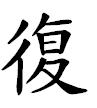
Fu is the Chinese name for hexagram 24. It means: return; repeat, repeatedly; return to a normal or original state. Parts of this Chinese character represent footprints going and coming back – a symbol indicating cyclic travel or change.


Hexagram 24 is often called "Return." It represents the month of the Winter Solstice, the "re-turn" or cyclical change back to longer daylight hours. The lines are comprised of the symbol for Thunder (the lower three lines) within the Earth (the upper three lines). The budding influence is the bottom yang/light line; all the lines above it are yin/darkness. This arrangement of the lines heralds that first moment of increasing daylight although the length of day is still very much shortened by the quiet, still, darkness of the longer nights.

~~~~~~~~~~~~~~~~~~~~~~~~~~~~~~~~~~~~~~~~~~~~~~~~~~~~~~~

Here is what the Yijing has to say about hexagram 24 and winter: a quote from the Richard Wilhelm I Ching translated into English by Cary F. Baynes, Princeton University Press/Bollingen Foundation Inc., New York, 1977, p. 506:

Hexagram 24, called Return or The Turning Point

The Image:

Thunder within the earth:
The image of The Turning Point.
Thus the kings of antiquity closed the [mountain] passes
At the time of the solstice.
Merchants and strangers did not go about,
And the ruler
Did not travel through the provinces.

~~~~~~~~~~~~~~~~~~~~~~~~~~~~~~~~~~~~~~~~~~~~~~~~~~~~~~~

If you've observed the evening sky this month, you've noticed that the handle of the Big Dipper (Ursa Major) is pointing toward the Northern horizon. North is symbolic of yin, night and darkness, cloudiness (the meaning of "yin" originated with the "cloudy" or "shady" side of a mountain; "yang" was the sunny side), underground, water, the downward direction (in Chinese feng shui and most maps, North is customarily at the bottom of the page), and valleys among other things; all things symbolic of serenity, non-action, responsiveness which means taking no initiatory action, but only responding to outside stimuli. Think of responsiveness this way: a seed in the ground takes no initiatory action, it doesn't decide when to grow; it sprouts in response to the stimuli of water from the rain and heat from the sun.

You might think that the Winter Solstice is the most yin day of the year but, technically speaking, that is not the case. The day before the Solstice is the most yin day; on the day of the Solstice, the Sun turns around and the days begin heading in the other (yang/light) direction.

In the Old Farmer's Almanac, I discovered that there is a city in Montana where, on the day of the Winter Solstice, the hours of daylight are exactly 1/3 the length of the hours of darkness, and 12:00 Noon almost exactly marks the middle of the daylight hours (it is off-center by only four minutes!). Sunrise occurs at 8:04 AM and sunset occurs at 4:04 PM giving eight hours of daylight and sixteen hours of darkness on the Winter Solstice day. (Yes, the Summer Solstice day there is exactly opposite, with sunrise occurring at 4:04 AM and Sunset at 8:04 PM!) That 1:2 ratio is important - it is Nature's message to us telling us how we should be utilizing (or, perhaps I should say restoring) our own energies at this time of year: one-third active, two-thirds passive.

(In case you are curious, I happened to discover this when I was searching for a location where Noon on the clock really was in the middle of the day (the sunrise-sunset cycle) on the day of the Winter (and Summer) Solstice. I don't have the almanac handy, but I believe the city is Glasgow, Montana.)

In the past, this time of year meant a time of rest for warriors and farmers alike, in fact for all segments of society. Even the ruler "did not travel through the provinces." After all, "the king closed the passes" restricting travel and therefore activity, possibly for the safety of the merchants and other people because traveling through the mountains in winter can be risky! (Some Daoists believe that even your qi flows more slowly in the winter.)

However, with technological advances, we've lost that connection with the cycles of Time and Nature. We can get up earlier, go longer, faster, and farther whatever the hours of daylight. Obviously this offers great advantages to our ability to produce, to get things done, to be active (yang), but it does rather go against the purpose of the yin season, to properly utilize this time given to us to rest, to reflect in silence, to attune with the universal energies. We listen to music on the radio instead of the sound of falling snowflakes (yes, they do make a sound when they land on the ground!). We turn on more electric lights instead of basking in the softness of the moon's reflection. It's a bit of a paradox that this time of year which should be our most quiet time often turns out to be our busiest time because of holiday parties and shopping. We have become quite out of harmony with Nature, Time, and the Dao. We no longer allow ourselves time to reflect, to rest in the solitude of the season of the night.

In the Five Phases of Energy, often called the Five Elements, water is the energetic signature for winter. It should always be our intention to live by the words "go with the flow"…emulate water; ever gently moving, following its course with quiet, soft determination, finding its own level. Water can carve through mountains with its persistence but that is a spring and summer activity. In the winter, even water "stops" – it freezes, ceases flowing, it is at rest. It falls from the sky as snowflakes; it solidifies into the mirror-like surface on a lake or pond – yet another symbol of the "reflective" quality of this season. If indeed we strive to emulate water, we must stop and be at rest, too.

When the body is at rest, the mind gains the time to reflect, and the spirit receives the energy to rejuvenate the body. This is the secret for a long and happy life.

I wish you all a harmonious, joyous, and stress-free new year!